How “APESHIT” Redefines Masterpiece
This assignment encourages creativity. “Write about a masterpiece,” the prompt broadly instructs, welcoming unconventional responses and interpretations — maybe a particularly beloved article of clothing or a warm, home-cooked meal. So it might seem a bit cowardly to write about “APESHIT,” a Beyonce and Jay-Z (together known as The Carters) music video shot in a museum famous for housing what critics have deemed mankind’s greatest masterpieces — the Louvre. Home to the likes of da Vinci’s enigmatic “Mona Lisa” and Delacroix’s Coldplay-popularized “Liberty Leading the People,” the Parisian monument seems like an unlikely setting for the music video of a song with an expletive in the title. But for six minutes and five seconds, Beyoncé and her husband stand regally in front of larger-than-life gilded frames while dancers in nude leotards move like water around them.
The video was released June 16, 2018 and has more than 250 million views. It begins with ethereal rings of a church bell and faint, echoed claps of high-heeled-steps in an empty room. We see several up-close shots of some of the Louvre’s paintings: the shadowed contours of a woman’s white veil, the quick, textured brushstrokes of an older man’s contorted face, an arm thrust into a blazing flame of red and yellow paint.
And then suddenly, the music starts. The synthesized, rubbery pulse of the song blares, punctuated by a man’s rhythmic vocalizations. The camera slowly moves through the cavernous halls of the Louvre. We see Beyonce and Jay-Z standing in colorful pantsuits in front of the Mona Lisa while gazing boldly and unflinchingly at the camera — at us.

To me, what makes this music video a masterpiece is its subversion of the meaning of “masterpiece.” When we hear the word, the artwork of White men invariably comes to mind: Mona Lisa, David, Starry Night, Scream, Sunday Afternoon on the Island of La Grande Jatte, American Gothic, Birth of Venus, Las Meninas, Girl with a Pearl Earring, Composition with Red Blue and Yellow, Guernica....the list could go on and on.
But The Carters directly challenge this way of thinking. They sever the line we instinctively draw between “masterpiece” and “White men,” instead foregrounding another kind of masterpiece, one that is un-frameable: Beyonce and Jay-Z themselves — or, more broadly, Black art and Black love.
If I were to go through each and every visually stunning moment of the music video, this response paper would be too long (and might take me an extra couple weeks to write!). Instead, I will focus on some of the standout shots and elements of the video. I also want to acknowledge that many Black thinkers have already critiqued this song, like Kimberly Drew and Alexandra M. Thomas. As a non-Black person, I am an outside viewer; my perspective without the lived experience of being Black in the U.S. is extremely limited. That being said, here’s my own — albeit narrowed — take on “APESHIT.”
One particularly prominent part of the music video is the dancers — all of whom are Black women wearing varying shades of brown leotards. They help accomplish the video’s main purpose: to center, spotlight, and revere Blackness, broadening the scope of the video beyond the Carters. Their presence signifies that “APESHIT” is not just about one Grammy Award-winning Black couple, but about Blackness itself — its strength, beauty, resilience, and power.


In one scene, Beyonce sits in front of the famous Winged Victory of Samothrace. The two seem to be mirroring each other; Beyonce’s voluminous, ribboned white gown mimics the marble wet drapery of the sculpture. But there’s an obvious difference. The Winged Victory of Samothrace is headless and immboile, a nonliving piece of rock carved more than two thousands years ago. Beyonce, on the other hand, is commanding and lively, looking straight into the camera as she raps and her body lurches to the beat. She is real. When the two are side by side, the sculpture seems obsolete by comparison, an antiquated and irrelevant vestige of the past. We wonder why it stands so high on the pedestal. We ask ourselves: who is the real masterpiece?
A couple years ago I visited La Plaza de Cultura y Artes, a Mexican-American museum and cultural center in Los Angeles. One of the exhibitions there, entitled “Make ‘Em All Mexican” by Linda Vallejo, also featured a reimagined Winged Victory of Samothrace. Titled La Victoria, it was a two-foot-tall sculpture that looked almost exactly like the original except for one crucial difference: it was covered in brown acrylic paint. To see such a famous sculpture with a deep brown hue and a glossy sheen was mesmerizing (and the reason why I took the picture!). “By changing the color,” UCLA cinema and media studies professor Chon Noriega explains, “it profoundly upsets not just what is in front of you, but the ideas of popular culture that you carry inside of you” (Miranda 2016).


La Victoria by Linda Vallejo



ut the ideas to which Noriega refers extend beyond present-day pop culture. The history of art — even Before the Common Era, as the Winged Victory of Samothrace dates back to 190 BCE — has been created and canonized by the West. Both Beyonce and Linda Vallejo reach far back into antiquity to kink this hegemonic historical narrative in its incipience. They challenge us to reevaluate our preconceived notions of highbrow and lowbrow art, of masterpieces and the mundane. What if the Winged Victory of Samothrace was Brown? What if she was Black?
There is another kind of masterpiece that takes center stage in “APESHIT”: Black love. Intermittent shots show Jay-Z and Beyonce warmly embracing each other or holding hands. The couple is a prominent cultural symbol of Black love, especially after repairing their mariage following Jay-Z’s infidelity (Spanos 2017). This relationship — one that has built mutual respect and trust from hardship — is the true work of art, they seem to say. In one of the scenes, the famous Venus of Milo stands behind them, but it is blurred out. What really catches our attention is the two of them assertively standing tall and holding hands in front of a rheumy, blue-lit backdrop.
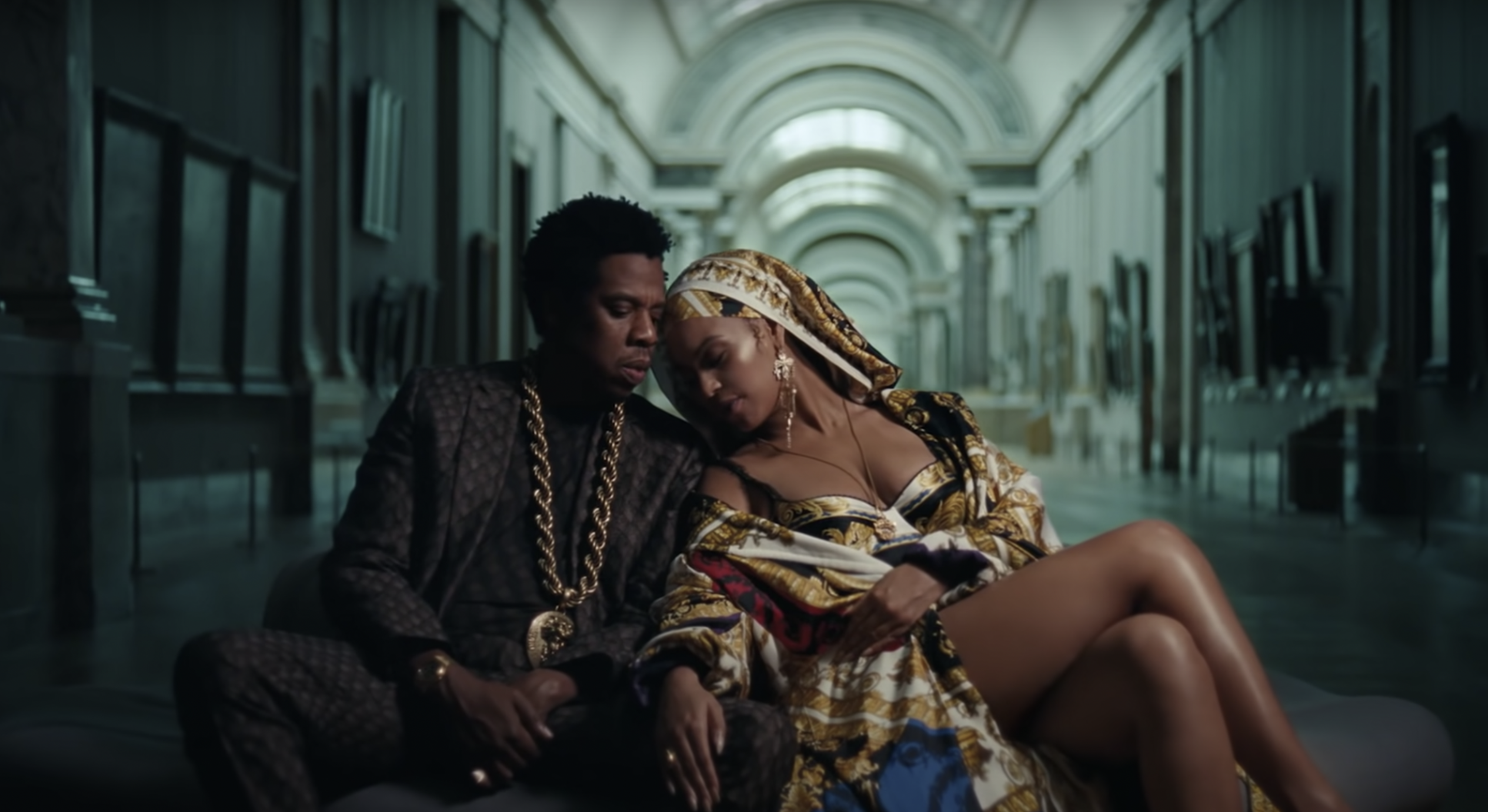
But as I mentioned before, The Carters are not just referring to themselves in this music video. They show that Black love in any form — even if it is not between an ultra-successful and mega-wealthy couple — is a masterpiece. They reconstruct the Louvre’s classical art with real, living Black subjects. In a particularly poignant shot, the painting of a woman embracing a man cuts away to a woman embracing her boyfriend on a bed in a small, orange-walled room. This juxtaposition provides yet another example of how Black love is the real splendor, not brushstrokes on a canvas. (I guess we could answer the question “Does life imitate art or does art imitate life?” with “Neither; life reinvents art and vice versa.”)

Analyzing the lyrics of “APESHIT” merits a whole separate essay (or maybe seven!), but I will point out a few verses in particular that I think are crucial to understanding the song. About two-thirds of the way through the video, Jay-Z begins rapping:
I said no to the Super Bowl, you need me, I don't need you
Every night we in the end zone, tell the NFL we in stadiums too (...)
Tell the Grammy’s fuck that oh for eight shit
Have you ever seen a crowd goin’ apeshit? (“APESHIT”)
Just as the music video rejects White standards of beauty, it also rejects White standards of success. The NFL has a long history of anti-Blackness; it is a White-led organization (Belson 2020) with a history of race-norming (denying Black players concussion settlements by arguing that their low cognitive scores are due to their race rather than their injuries) (Zirin 2021). But after the league blackballed Colin Kaepernick following his decision to take a knee protesting anti-Black police brutality in 2016, many Black artists directly boycotted them (Moore 2018). Rihanna, Cardi B, Nicki Minaj, and a slew of other stars turned down an opportunity to headline the Super Bowl halftime show (Grady 2019). Jay-Z references this unprecedented turn of events, in which a White-led, century-old, multi-billion-dollar corporation began begging Black artists to perform and boost ticket sales.
Similarly, the Grammys have snubbed Black artists for decades — Beyonce losing to Adele in 2017 or The Weeknd’s 2021 nomination exclusion, for example — and pigeonholed them into R&B and rap genres (Sisario 2021). The “oh for for eight shit” line references the 2018 Grammys in which Jay-Z had eight nominations — making him the most recognized artist of the year — but did not win a single one (Howard 2018). That being said, The Carters have actually won 51 Grammys (yes, you read that right!) between the two of them. For Jay-Z to diss the Grammys given his relative success makes this verse all the more scathing. They may have 51 awards, he seems to say, but don’t forget about the 108 other nominations that went unrecognized.
As Jay-Z asserts, he doesn’t need the Super Bowl — they need him. He names the unexpected yet pronounced power differential between Black artists and mainstream White establishments. Jay-Z and other Black artists who boycotted the annual championship game are “in the end zone,” implying that they are winning in a different sense — selling out concert tickets and accruing millions of dollars. He talks directly to the institutions that have failed to respect not only him and his wife, but all Black Americans. The Carters declare that they have grown beyond anti-Black football leagues and recording academies, finally unencumbered by their dehumanizing conventions and codes. After all, their crowds are going “apeshit” — so who cares about the NFL or the Grammys? And with more than 250 million YouTube views for this music video alone, I can’t see how they’d be wrong.
The Carters’ decision to title the song “APESHIT” is not insignificant. The word — which is in all caps — evokes images of tumultuous throngs of excited concert-goers or the eruption of cheers in a bar once the favored football team scores. The audiences at Jay-Z and Beyonce’s shows are going “apeshit,” coming in droves just to see them perform. But the word has a negative connotation, too. As Urban Dictionary very helpfully illuminates, “apeshit” can also mean “[t]o go completely off the deep end; succumb to extreme rage” (Lil Ringo 2007). And it does seem like The Carters are going “off the deep end” — they’re angry. Angry at how the Grammys snub Black artists, how the NFL robs Black players, how the United States commits violence against Black Americans every day. In this music video, they “succumb to extreme rage” by rejecting the supremacy of White art. Instead, they make their own art.
In the final scene of the music video, Beyonce and Jay-Z take one last lingering look at the camera and each other before slowly turning around to face the Mona Lisa. The Carters, who were previously the art and objects of consumption, now join us as the viewers. Suddenly, we re- evaluate our gaze. How would we look at the Mona Lisa with Beyonce and Jay-Z standing beside us? How do they view White art? How do Black Americans view White art — especially when it has been glorified at the expense of their erasure and exploitation? What is the real masterpiece: the 500-year-old painting or the song itself? Since The Carters are selling out stadiums worldwide and their crowds are going apeshit, I’d venture to guess the latter.
Belson, Ken. “In competition for top jobs, in the NFL and beyond, it pays to be a white man.” Chicago Tribune, 12 Jan. 2020, www.chicagotribune.com/sports/national-sports/sns-nyt-white-hires-nfl-beyond-20200112-f44qbbyaebgd7g4qiutiitqgsm-story.html.
“THE CARTERS - APESHIT (Official Video).” YouTube, uploaded by Beyonce, 16 June 2018, https://www.youtube.com/watch?v=kbMqWXnpXcA.
Grady, Constance. “The Super Bowl halftime show controversies, explained.” Vox, 3 Feb. 2019, www.vox.com/culture/2019/2/1/18202128/super-bowl-2019-liii-53-halftime-show-controversy-maroon-5-travis-scott-big-boi.
Howard, Jacinta. “JAY-Z Was Nominated for Eight Grammys, But Didn’t Win a Single One.” The Boombox, 28 Jan. 2018, www.theboombox.com/jay-z-was-nominated-for-eight-grammys-he-didnt-win-a-single-one/.
Lil Ringo. “Apeshit.” Urban Dictionary, 30 Sept. 2007, www.urbandictionary.com/define.php?term=apeshit.
Miranda, Carolina A. “In her series ‘Make ‘Em All Mexican,’ artist Linda Vallejo imagines #OscarsSoBrown.” Los Angeles Times, 19 Feb. 2016, www.latimes.com/entertainment/arts/miranda/la-et-cam-linda-vallejo-oscarssobrown-make-em-all-mexican-20160218-column.html.
Moore, Jack. “At least the NFL isn't pretending it's not blackballing Colin Kaepernick.” The Guardian, 13 April 2018, www.theguardian.com/sport/2018/apr/13/kaepernick-reid-blackballed-nfl-kneeling-anthem.
Sisario, Ben. “Grammys Ready Pandemic Show, as the Weeknd Boycotts Future Awards.” New York Times, 11 March 2021, www.nytimes.com/2021/03/11/arts/music/grammys-the-weeknd-beyonce.html.
Spanos, Brittany. “How Jay-Z’s ‘4:44’ and Beyonce’s ‘Lemonade’ Redefine Black Love, Fame.” Rolling Stone, 30 June 2017, www.rollingstone.com/music/music-features/how-jay-zs-444-and-beyonces-lemonade-redefine-black-love-fame-205200/.
Zirin, Dave. “The NFL's institutionalized racism is just one part of a massive problem.” MSNBC, 8 June 2021, www.msnbc.com/opinion/nfl-s-institutionalized-racism-just-one-part-massive-problem-n1269966.